|

1652 A
|
a
|
1652 A
|
b
|
Monologue on Bill Johnson, early jazz bands, and band leaders — sp/p
|
c
|
Jelly Roll (12)
Ragtime tunes of the first cabarets
see stenographic notes, Jelly 72.
Salty Dog (1)
Bill Johnson had the first jazz band to go to N.Y.
(to Jelly Roll 2 — Wm Johnson Story)
|
d
|
THE SALTY DOG
“They came to Chicago and turned the town upside down.”
|
e
|
Circle jm-64 (excerpt)
|
f
|
Rounder CD 1091 as: SALTY DOG (excerpt)
|
g
|
Rounder CD 1888 as: Salty Dog / Bill Johnson, Jelly’s Brother-in-Law
|
|
Salty Dog
That one had a name, that was the “Salty Dog.” That’s the “Salty Dog” . . .
[inaudible comments]
Do you know the words to some of that? Huh? No, er, that wasn’t mentioned in there . . .
“Let me be your salty dog . . .” Yeah . . . No — it’s the “Salty Dog.”
Old salty dog,
Old salty dog,
Old salty dog.
That’s about all the names there. That’s all, all the words there was.
Old salty dog,
Old salty dog.
That’s the way that Bill Johnson used to play — him and his three-piece organization. Er, Bill Johnson’s a brother-in-law of mine — and is older than I am — very, very good-looking boy in those days. And my, and how did the girls take to him, and those bad chords on the bass fiddle. My, [laughs] they really taken to him, I’m tellin’ you.
Was he the one that took the first jazz to New York? Er, yeah, Bill Johnson was the first one that taken the first jazz band into the city of New York. Er, they played the Palace Theater. Well, I’m a little bit ahead of my story.
[inaudible comments] Er, Bill . . . Bill wanted to come to California and, er, in the meantime, he wrote my wife a letter, and she financed the trip. He had a band. He’d composed this band formerly of some of the Tuxedo Orchestra, which was Freddie Keppard’s old original orchestra, which was the first combination of what is known now as a Dixieland combination. But, of course, this band was augmented a bit — from the Dixieland combination. They had added, then, the guitar and the bass fiddle. Of course, Bill seen the opportunity, so he got into the band and got the bass fiddle and got the band for himself.
So he . . . we’s financed the trip and came to Los Angeles. On entering Los Angeles, they made such a tremendous success that the Pantages Circuit signed them up immediately. That was the year of nineteen-thirteen. And they made the trip throughout the country of the Pantages Circuit, which was the largest circuit at that time in the world. And through this trip they came East, and they came into Chicago in early nineteen-fourteen. I happened to be there myself, with a similar combination of what Freddie Keppard used to have, which was considered a Dixieland . . . which is considered now a Dixieland combination.
They came to Chicago and turned the town upside down. Caused my trumpet player to quit, which was considered the best trumpet player in Chicago at the time. His name was Armstrong.
What? But not Louie Armstrong. [laughs] It was John Armstrong of Louisville, Kentucky. And John couldn’t play that kind of trumpet. And I had been teachin’ him a little bit, and he was little stubborn, and when Freddie played, he wanted to hit me with a rack. When I mean a rack, that is something that’s very . . .
Note: For detailed information about Freddie Keppard and Bill Johnson, as mentioned in the narrative above, readers are recommended to consult the widely-acclaimed book: Pioneers of Jazz: The Story of the Creole Band by Prof. Lawrence Gushee. 

1652 B
|
a
|
1652 B
|
b
|
If I Was Whisky and You Was A Duck — v/sp/p
|
c
|
More early Cabaret tunes
Hesitation Blues really composed by Sidney Smythe (white) from Louisville, Ky. in 1913
|
d
|
IF I WAS WHISKEY AND YOU WAS A DUCK
|
e
|
Circle jm-89
|
f
|
Rounder CD 1091 as: HESITATING BLUES
|
g
|
Rounder CD 1888 as: Hesitation Blues
|
|
Hesitation Blues
Long time, people thought I wrote this tune. I used to sell ‘em just a little bit, er, lead copies for thirty-five cents then. I kept the sheet music so nobody could see it.
If I was whisky and you was a duck,
I’d dive to the bottom and I’d never come up,
Oh, but how long do I have to wait?
Can I get it now — do I have to hesitate?
If I had a woman, she was tall,
She make me think about my parasol,
Oh, how long do I have to wait?
Can I get it now — do I have to hesitate?
Know an old lady by the name of Jane,
I hit and knocked her right off her cane,
Oh, how long do I have to wait?
Can I get it now — do I have to hesitate?
Mama, mama look at sis,
She’s out on the levee doin’ the double twist,
Lord, for how long do I have to wait?
Can I get you now — do I have to hesitate?
She said, “Come in here, you dirty little sow,
You tryin’ to be a bad girl, you don’t know how,”
How long do I have to wait?
Can I get you now — do I have to hesitate?
She said, “Touch my bonnet, touch my shawl,
Do not touch my waterfall,”
Oh, how long do I have to wait?
Yes, if I get you now — won’t have to hesitate.
There’s a girl sittin’ on the stump,
I know, I know she’s on the stump,
Just for how long — This is a dirty little verse — ah, do I wait,
Couldn’t say that — Say it — [laughter] — Oh, it can be dirty — Don’t mind me
Can you get you now — do I have to hesitate?
Piano interlude
Tell me, babe, what you’ve got on your mind
I’m eatin’ and drinkin’, havin’ a lovely time,
How long — do I wait?
Yes, to get you now — do I have to hesitate?
1653 A
|
a
|
1653 A
|
b
|
They Called Her Frivolous Sal — v/sp/p
|
c
|
Jelly Roll (13)
How he heated up a sentimental tune in 1906. — Frivolous Sal
|
d
|
MY GAL SAL
|
e
|
Circle jm-72
|
f
|
Rounder CD 1091 as: MY GAL SAL
|
g
|
Rounder CD 1888 as: My Gal Sal
|
|
My Gal Sal
This was a real favourite in the city of New Orleans.
About when? Well, about, er, the year of nineteen-six, nineteen-seven.
They call her “Frivolous Sal,”
A peculiar sort of a gal,
With a heart that was mellow,
An all round good fellow,
Is my old pal.
For troubles, worries and cares,
She’s always willing to share,
A wild sort of a devil,
But dead on the level,
Was my gal Sal.
This was my transformation, one of the first to transform . . . in the business. Of course, I used to transform ‘em all the same way.
My Gal Sal [transformation]
They call her just Frivolation Sal, babe,
Yes, that peculiar sort of a gal,
Heart that was mellow,
All round good little fellow,
She’s, she’s my old pal.
Yes, them troubles, worries and cares,
She’s always willing to share,
Wild sort of little devil,
Just knows, babe, she’s on the level,
She’s my, she’s my gal Sal.
Yes, them cold people miss Sal,
A peculiar sort of a gal,
Heart that’s mellow,
Yes, all round good little fellow,
She’s my old pal.
Oh, them troubles, just worries and cares,
She’s always willing to share,
Yes, wild sort of little devil,
Just know my baby’s on the level,
She’s my, my gal Sal.
1653 B
|
a
|
1653 B
|
b
|
Maple Leaf Rag — sp/p
|
c
|
Rag-time, Missouri style.
(2) Maple Leaf Missouri style.
|
d
|
I. RANDALL’S RAG
II. MAPLE LEAF RAG, Part 1 (St Louis Style)
|
e
|
Circle jm-21 (excerpt)
|
f
|
Rounder CD 1091 as: RANDALL’S TUNE (excerpt)
Rounder CD 1091 as: MAPLE LEAF RAG, St. Louis tempo, begun (excerpt)
|
g
|
Rounder CD 1888 as: The St. Louis Scene
|
|
[inaudible comments] All right. Er, this tune . . . You ready now?
Yeah. Er, this tune, I never really know the name of it, but it seems to be a tune that everybody played around St. Louis in the early days.
When? Er, well, around nineteen-eleven, twelve, and like that. There wasn’t very many good piano players around there, with the exception of Tom Turpin. And even a little earlier than that, er, Scott Joplin. He was around. And, er, Louis Chauvin no doubt was, er, among the best. And none of these boys read any music, with the exception of Artie Matthews, to amount to anything. Of course, they were good composers and things like that. And they always had arrangers to take the tunes down.
The time that I came into St. Louis . . . I came in, I was afraid that I’d meet somebody that could top me a whole lot, so I wouldn’t admit that I could play. So when I went in I, I claimed that I was a singer, because I would . . . I just had came off circuits and things like that. And I was afraid.
I was hired at a club called the Democratic Club. That was a nightclub. Run by . . . the proprietor’s name was Noah Warrington. And he had a pianist there called George Randalls. He was supposed to be one of the best. This is one, er, one of his best tunes. It’s played just about the way I’m going to play it.
Randall’s Tune
Of course, er, they had some very good hot tunes around. George couldn’t read, and they had a lot of ‘em. Like Bob Hamilton — played pretty good — in fact real good. But of course he couldn’t read any music, and, er, it was pretty tough when we get those tough tunes. “Maple Leaf Rag” was a great rag during that time, even way back in nineteen-four. And it was one of the best rags. It was played in about this way in St. Louis, but maybe — I say I hate to make the remark like that — but maybe not as good. Because the boys couldn’t finger so good.
Maple Leaf Rag [St. Louis style begun]
Note: Jelly Roll refers to a pianist in St. Louis he calls George Randalls on AFS 1653-B (above), but on AFS 2487-B [q.v.] he calls him George Reynolds — his correct name. George Reynolds was born in St. Louis, Missouri in 1888, and is recorded in both the 1910 and the 1920 U.S. Census as a resident of that city. His occupation was listed as a musician. He went to Chicago in the 1920s and recorded for Paramount Records in 1926 with a band led by Preston Jackson. He also recorded with Richard M. Jones’ Jazz Wizards in 1935. [PH 6]
Note: Bob Hamilton mentioned by Jelly Roll above, is very probably the ragtime pianist and composer Robert Hampton.
1654 A
|
a
|
1654 A
|
b
|
Monologue on St. Louis ragtime — sp/p
|
c
|
J. Roll Morton (14)
B B2 completed
Maple Leaf Rag played in New Orleans Style.
|
d
|
I. MAPLE LEAF RAG, concl. (St. Louis Style)
II. MAPLE LEAF RAG (Morton’s transformation)
|
e
|
Circle jm-22 (excerpt)
Circle jm-65 (excerpt)
|
f
|
Rounder CD 1091 as: MAPLE LEAF RAG, St. Louis tempo, concluded (excerpt)
Rounder CD 1091 as: MAPLE LEAF RAG, Morton style, (excerpt)
|
g
|
Rounder CD 1888 as: Maple Leaf Rag, St Louis style / Maple Leaf rag, New Orleans style
|
|
Maple Leaf Rag [St. Louis style concluded]
That was the way they played it in Missouri. Of course, I played the same tune. I had played it, I guess, long before I went to the state of Missouri. And I played it in a different, in a different tempo. That is on the version of my creation of jazz music. In fact, I changed every style to mine.
Maple Leaf Rag [New Orleans style]
That was the style that I played it in New Orleans. In my estimation it’s a vast difference. How much you have you got on there left?
A little bit more. Tell the story about the time you had in . . . After I arrived in St. Louis, and I decided to not tell anybody I could play piano . . . My goodness, the snow was piled up, you couldn’t see the streetcars. I never seen such a snow in all my life. I just had left, er, Johnny and Reb Spikes, the boys that wrote “Someday Sweetheart.” In fact their name is on it. So of course they’ve got the full claim to it. We had left McCabe’s Minstrels. I quit the show in St. Louis, and that’s why I happened to be there.
Note: Research carried out by Prof. Lawrence Gushee suggests that Jelly Roll’s arrival in St. Louis probably occurred in February 1914. The front-page article of the St Louis Post-Dispatch, dated Friday, 13th February 1914 gives an account of the snowstorm as described above by Jelly Roll. [SLPD]
1654 B
|
a
|
1654 B
|
b
|
Monologue on St. Louis ragtime — sp/p
|
c
|
Ragtime in St. Louis
|
d
|
ST. LOUIS “That guy’s a shark.” (see footnote)
|
e
|
Circle jm-65 (excerpt)
|
f
|
—
|
g
|
Rounder CD 1888 as: Jelly Roll Carves St. Louis
|
|
Well, anyway, after I applied for the job and I got the job. They had a singer there — it was a man singer . . . at this very club. His name was Spec. I never . . . I don’t remember his first name or his last name. I don’t think I’ve ever heard either one of his names, with the exception of Spec. Spec had a rough . . . oh, a terrible voice. I had a bad voice myself, very bad, but not as bad as Spec’s. Spec was a real favourite. He used to sing some kind of a song about the doctor’s application — what’s good for you. That meant somethin’ about food. Tell all about the different foods. When you had different diseases. That was good for the different diseases, was the food. Spec didn’t come to work until late. Since I went to work at nine o’clock in this place and Spec didn’t get off till twelve or one o’clock at the other job he was working and we stayed till four and five o’clock in the morning at this place.
So, of course, George who was a little bit chesty — that’s the piano player — because all the girls was around trying to make eyes at him, and he’s a fairly nice looking fellow, and he was known to be the best in town. And I thought right away if he’s the best in town, I thought he was very . . . very, very bad. Terrible to be exact. So I asked George to play me a tune, and he didn’t seem to want me to be working in the place. So he played the tune — didn’t look like he was very much particular about playin’ it. I told him, I said, well, er, one of these tunes he played, I said, “You don’t play that right.” I said, “I’d like you to have a little more pep in this thing here because it helps me out a little bit.”
He says, “Well, if you don’t like the way I’m playin’ it, play it yourself,” not knowing that I could play.
[laughs]
I says, “Well, okay. If you don’t play my tunes right, you don’t have to play ‘em. I can play ‘em myself.”
He said, “There’s the piano. Play it.”
So I got up and I played the tune. And where, where I told him the mistakes were, he found I was really telling the truth.
What’d you play, Jelly? I don’t remember the tune that I played at that time. But it was some popular tune. And he couldn’t play it correct. Immediately, he had a great big broad smile on his face. Seeing that I was superior to him, he wanted to make friends with me. Of course, I didn’t object and gotten to be friends right away.
From then on he asked me . . . He had a lot of music and lined it up on the piano. Just, just a little bit of portions of it so he could tell the music — not that he could use it, because he couldn’t play by music. And he asked me, did I read music. And I told him “a little bit.”
‘Course he gave me the different difficult numbers that he thought was difficult. And they were all simple to me, because I knew ‘em all, anyway. And I played everything he had. By that time, he started getting in touch with different piano players around that was supposed to be good readers, and other good musicians that supposed they could play very good on their instruments, which was nothing but brass band instruments. They never had no . . . bands at all around there.
So they finally start to bringing me different tunes. They brought me all of Scott Joplin’s tunes. I knew ‘em all by heart anyhow, at that time. So I played ‘em all.
[laughs]
They brought me James Scott’s tunes. I knew ‘em all. They brought me a few from Louis Chauvin. I knew ‘em all.
They brought me Artie Matthews’ “Pastimes.” In fact, Artie Matthews himself brought ‘em down. But I didn’t know it was Artie. I had played his tunes. So that he decided to find out whether I could either, er, really play piano, or not, and could really read. Artie was supposed to be the best reader of, of all of ‘em among the whole St. Louis bunch.
So Artie brought me down some light operas, such as, er, Humoresque and things like that. Well, I knew them all anyway. So he decided to bring down Martha, an overture. And Martha was somethin’ I had been rememberin’ for years, at that time. So that was all okay. At that particular time . . .
Note: The title of Circle jm-65 is shown as ST. LOUIS “That guy’s a shark.” It would appear that this is an error by Circle, as the spoken words, “That guy’s a shark” only appear on Circle jm-66.
1655 A
|
a
|
1655 A
|
b
|
Low Down Blues — v/sp/p
|
c
|
—
|
d
|
THE MISERERE “So I swung a few of these operatic tunes.”
|
e
|
Circle jm-66 (excerpt)
|
f
|
Rounder CD 1091 as: THE MISERERE (excerpt)
|
g
|
Rounder CD 1888 as: Jelly Roll Carves St. Louis, continued
|
|
[inaudible comments] . . . Okay. As I said, they brought me a lot of light operas, including “Miserere” from Il Trovatore and so forth and so on, like that. And finally, they brought me Poet and Peasant. It seems like in St. Louis, if you was able to play Poet and Peasant correctly, you was really considered the tops. And the man that brought it to me was supposed to be the best musician in town. And it seems like he wasn’t able to master this piece himself.
I had known this tune for many years, and had played it in recitals and so forth and so ons, and, and light concerts and things. And they placed this number in front of me, and I started looking at it like I’ve never seen it before — which I had rehearsed it maybe two months before I was able to play it.
And I start playing this number. So I got to a passage, and this passage was a very fast passage, and I had to turn the page over. But it was impossible for me to turn the page o-over due, due in, er, er, due to the fact that, er, this passage was so fast. And I had to manipulate it so fast I couldn’t turn it over, even though I knew the tune. And Mr. Matthews grabbed the tune from in front of me, which was Poet and Peasant, and said, “Hell, don’t be messing with that guy. That guy’s a shark.”
And I told ‘em, “Boys, I been kiddin’ you all the time.” Say, “I knew all these tunes anyhow.”
So I swung a few of these operatic tunes for ‘em like, er, “Miserere” from Il Trovatore in my style.
Miserere [swung]
I combined the “Anvil Chorus” with it.
1655 B
|
a
|
1655 B
|
b
|
Low Down Blues — v/sp/p
|
c
|
—
|
d
|
LOWDOWN BLUES
(“I could sit right here and think a thousand miles away.”)
|
e
|
Circle jm-57
|
f
|
Rounder CD 1091 as: LOW-DOWN BLUES (NEW ORLEANS BLUES)
|
g
|
Rounder CD 1888 as: New Orleans Blues
|
|
Low Down Blues
I could sit right here and think a thousand miles away,
Sit right here and think a thousand miles away,
Have the blues, I cannot remember the day.
Tell me, babe, what’s on your mind,
Tell me, baby, what’s on your doggone mind,
Tell me, baby, what’s on your doggone mind.
I never believe in havin’ no one woman at a time,
Never believe in havin’ one woman at a time,
I always have six, seven, eight or nine.
I said, “Babe, oh, baby, babe,
Oh, babe, oh, baby,
You got to set your papa crazy.”
I got a sweet woman, she lives right back of the jail,
I got a sweet woman, who lives right back of the jail,
She’s got a sign on the window, good cabbage for sale.
My gal’s got a Hudson, her pal’s got a diamond ring,
My gal’s got a Hudson, her pal’s got a diamond ring,
Her sister’s got a baby, from shakin’ that thing.
Oh, got the lowdown blues, got ‘em lowdown blues,
Oh, lowdown blues, yes, lowdown blues,
I got the lowdown blues, too doggone make you cry.
Do you see that spider crawlin’ up that wall,
Do you see that spider crawlin’ up the wall,
She’s goin’ up there to get her ashes hauled.
Yes, got the lowdown blues, got the lowdown blues,
Got the lowdown blues, oh, lowdown, lowdown blues,
Got the lowdown blues, to doggone make you cry.
1656 A
|
a
|
1656 A
|
b
|
The Winding Boy — v/p
|
c
|
Jelly Roll (16)
I’m the Windin’ Ball, Don’t Deny My Name
(Tom Cat Stomp)
|
d
|
—
|
e
|
—
|
f
|
Rounder CD 1092 as: WININ’ BOY BLUES no. 1, begun
|
g
|
Rounder CD 1888 as: Winin’ Boy Blues
|
|
Winin’ Boy Blues [begun]
I’m the Windin’ Boy, don’t deny my name,
I’m the Windin’ Boy, don’t deny my name,
Windin’ Boy, don’t deny my name,
Pick it up and shake it like Stavin’ Chain,
I’m the Windin’ Boy, don’t deny my name.
Windin’ Boy, don’t deny my name,
I’m the Windin’ Boy, don’t deny my name,
I’m the Windin’ Boy, bred to fame,
I shook that thing like it’s game,
Windin’ Boy, and don’t deny my name.
I seen that gal, she’s sittin’ on the stump,
I seen that gal, she was sittin’ on the stump,
I seen the gal, sittin’ on the stump,
I screwed her till her pussy stunk,
I’m the Windin’ Boy, don’t deny my name.
I met that gal, met her on the grass,
I met that gal, met her on the grass,
I met that gal, met her on the grass,
I pulled that snake right from her big ass,
Lord, I’m the Windin’ Boy, and I don’t deny name.
Dime’s worth of beefsteak and a nickel’s worth of lard,
Get a dime’s worth of beefsteak and a nickel’s worth of lard,
Yes, a dime’s worth of beefsteak, nickel’s worth of lard,
I’ll salivate your pussy till my peter get hard,
I’m the Windin’ Boy, don’t deny my name.
Every time the changin’, changin’ of the doggone moon, ba ba la ba boh,
Every time the changin’ of that doggone moon,
Every time the changin’ of the moon,
The blood come rushin’ from the bitch’s womb,
I’m the Windin’ Boy, yes, I don’t deny my name.
1656 B
|
a
|
1656 B
|
b
|
The Winding Boy — v/p
|
c
|
same, concl’d.
|
d
|
WININ’ BOY No. 1
|
e
|
Circle jm-60 (excerpt)
|
f
|
Rounder CD 1092 as: WININ’ BOY BLUES no. 1, concluded
|
g
|
Rounder CD 1888 as: Winin’ Boy Blues, continued
|
|
Winin’ Boy Blues [concluded]
That’s dirty here . . .
[inaudible comments] And again?
[inaudible comments] “Windin’ Boy” again?
Yes, Windin’ Boy, don’t deny my name,
Windin’ Boy, don’t deny my name,
Windin’ Boy, don’t deny my name,
Pick it up and shake it like Stavin’ Chain,
I’m the Windin’ Boy, don’t deny my name.
I want a mama, that’s nice and kind,
I want a mama, baby, that’s nice and kind,
I want a mama, sweet and kind,
So she can shake that big behind,
I’m the Windin’ Boy, don’t deny my name.
I like a gal that’s good to me,
Yes, like a sweet mama, that’s good to me,
I like a sweet little mama, good to me,
Let me have that thing really free,
I’m Windin’ Boy, don’t deny my name.
Oh, little Windin’ Boy, don’t deny my name,
I’m the Windin’ Boy, don’t deny my name,
Yes, Windin’ Boy, don’t deny my name,
I pick it up and shake it like Stavin’ Chain,
Windin’ Boy, don’t deny my fuckin’ name.
When I see that gal comin’ back to me,
When I see my gal comin’ back to me,
When I see my bitch comin’ back to me,
I know I’m gonna make her sing ‘Nearer, My God, to Thee,’
Windin’ Boy, don’t deny my name.
Note: Circle jm-60 does not contain the spoken introduction or inaudible comments, and the underlined profanity in the last line of the fourth verse is edited out.
1657 A
|
a
|
1657 A
|
b
|
The Animule Dance — v/p
|
c
|
—
|
d
|
THE ANIMULE BALL, Part 1
|
e
|
Circle jm-9
|
f
|
Rounder CD 1092 as: THE ANAMULE DANCE, begun
|
g
|
Rounder CD 1888 as: The Anamule Dance
|
|
The Animule Dance [begun]
Take it a little bit easier . . . All right.
Oh, squata lada labo,
Baba daba laba daba labo,
Baba babo baa-bo.
[inaudible comments] Ladies and gentlemen, we now in the jungles.
We are broadcastin’ from Station J-I-N, — JIN, “The Breath of a Nation.”
Everyone of you are animules.
You should be walkin’ on four legs, but you’re now walkin’ on two.
You know, you come directly from the animule fam-i-lee.
What is it that I see coming through the weeds?
Just as tall as they can be, all speckled and striped,
That they haven’t got a collar and tie on. Hmm, hmm, I know ya.
Why, you’re just so tall, you can eat trees from the leave,
And never bend your knees.
Yes, I understand, this is Mister G. Raffee.
Who’s that other big fellow that’s followin’ right in your tracks?
Why, it looks like he’s got dirty clothes on.
Look like they was one . . . white once, but they’ve gone darker.
Ha, I think I can see, why, he’s got a trunk with him.
Oh, yes, I realise who that is.
That’s Mister L. E. Phant.
Who’s that little bitty thing that’s walking through the weeds, there,
With the hair all over its head?
That look like Aunt Dinah’s little bitty children.
I see — it looks like it’s kinda angry.
Oh, I know what that is, that’s a Lady Porcupine.
There’s something walking straight up on two legs.
What is that? Oh, I know,
That’s a cross between a gorilla and a rang-u-tang —
A little bitty ring-tailed monkey.
Yes, we’re right in the animule field.
And another thing I want to tell you people with clothes on —
You have tails just the same, but you’re wearing clothes and you can’t see them.
[inaudible comments]
Way down in jungle town,
For miles around,
They used to give a ball,
Every night at the animule hall.
The band began to play,
They began to shout, you’d laugh —
Ha, ha, ha, Lord, till your sides would crack,
When they call them doggone figures out.
The monkey hollered, “Run, I say.”
Wildcat did bambochay,
Tiger did the mooch,
And the elephant [snaps fingers for the break] did the hoochy-ma-cooch.
That pant’er did that eagle rock and began to prance,
In the jungles at that animule dance.
1657 B
|
a
|
1657 B
|
b
|
The Animule Dance — v/p
Scat Song [not mentioned in AFS catalogue]
|
c
|
—
|
d
|
I. THE ANIMULE BALL, Part 2
II. SCAT SONG
|
e
|
Circle jm-10
|
f
|
Rounder CD 1092 as: THE ANAMULE DANCE, concluded (excerpt)
Rounder CD 1092 as: SCAT SONG (excerpt)
|
g
|
Rounder CD 1888 as: The Anamule Dance, continued
|
|
The Animule Dance [concluded]
This am the second strain of the Animule Dance.
Why, the lion came through the door,
Ha. You could tell that lion was posilutely sore.
“Let me in the hall.” “What you gwine-a do?”
“I’m gwine break up this doggone animule ball, yeah.”
“Don’t you think I want to dance?
Give me one more chance.”
And the lion gave up a roar, [descending glissando]
Tore down that door,
Broke up the animule ball.
Yes, the monkey hollered, “Run, I say.”
Wildcat did the bambochay,
Tiger did the mooch,
And the elephant [claps hands for the break] did the hoochy-ma-cooch,
That pant’er did that eagle rock and began to prance,
Way down in the jungles at the animule . . . Oh —
The monkey hollered, “Just run, I say.”
The wildcat did the bambochay,
Tiger did the mooch,
And the elephant did that hoochy-ma-cooch.
That pant’er did the eagle rock and began to prance,
Down in the jungle at the animule dance.
Plays chords softly as he speaks
You see, the “Animule Dance” is a number that was ages old. I wrote the number and ten thousand claimed it. I don’t believe it’s ever been published. I don’t guess it ever will be published. Or maybe it will. Since so many claimed it, I thought I wouldn’t try to claim it. But there’s nobody ever been able to do it so far but myself.
When did you write it? Oh, that was wrote around nineteen-six. Right after the “New Orleans Blues” was wrote and the “Winin’ . . . Winding Ball.” Of course, that’s an unknown tune right now — the ‘Winding Ball.’ But it was a very big hit for the time, in New Orleans, around the Tenderloin District. That was one of the numbers I made a lot of money on — “Winding Ball.” And I also made a lot of money on this number, too, er, which is known as the, the “Animule Dance.” Of course that means animals.
Well, what about some more scat songs . . . that you used to sing way back then? Oh, I’ll sing you some scat songs. That was way before Louie Arm . . . Armstrong’s time. Er, by the way, scat is something that a lot of people don’t understand they . . . and they begin to believe that the first scat numbers was ever done, was done by one of my hometown boys, Louie Armstrong. But I must take the credit away, since I know better. The first man that ever did a scat number in history of this country was a man from Vicksburg, Mississippi, by the name of Joe Sims, an old comedian. And from that, Tony Jackson and myself, and several more grabbed it in New Orleans. And found it was pretty good for an introduction of a song.
What does scat mean? Er, scat doesn’t mean anything but just something to give a song a flavour. For an instance we’ll say:
Scat, skeet, skee, do doodle do,
Skeet, skuld, skoot, do doodle do,
Skoodulah ball, be-duh-be-dee zoot zoot zu,
Skwadab, ah skwazap, skwazeh, I said skweedle-dee-do,
Be-be-be-deep, boddle-ee baloot-a da bah bah baba hah-duh-jop,
Ah, skoojle-itle skoodle-ee do, just skoojud-eet skoodle-ee do,
Ah, skoojle-it skoodle-ee do, ohh skweedle-ee,
Dee dee dis skwad da-be-da-ba,
Skoojle-itle skoodle-ee do, yeah skoojle-it skoodle-dee do,
Oh skoojle-it scat scat sba-de-be-da,
Scat skoojun-it skoodle-ee do.
1658 A
|
a
|
1658 A
|
b
|
Monologue on early blues and Buddy Bolden — v/sp/p
|
c
|
Jelly Roll (18)
Nasty Butt, Stinking Butt, Take It Away
(I Thought I Heard Buddy Bolden Say)
This tune was popularized as The St. Louis Tickler
Story of Buddy Bolden.
|
d
|
THE BUDDY BOLDEN LEGEND Part I
|
e
|
Circle jm-77 (excerpt)
|
f
|
Rounder CD 1092 as: BUDDY BOLDEN’S BLUES
|
g
|
Rounder CD 1888 as: The Great Buddy Bolden / Buddy Bolden’s Blues
|
|
Buddy Bolden’s Blues
This is about one of the earliest blues. Er, this is, no doubt, the earliest blues that was the real thing. That is a variation from the real barrelhouse blues. The composer was Buddy Bolden, the most powerful trumpet player I’ve ever heard, or ever was known. The name of this was named by some old honky tonk people. While he played this, they sang a little theme to it. He was a favourite in New Orleans at the time.
I thought I heard Buddy Bolden say,
Dirty nasty stinkin’ butt, take it away,
A dirty nasty stinkin’ butt, take it away,
Oh, Mister Bolden, play.
I thought I heard Bolden play,
Dirty nasty stinkin’ butt, take it away,
A funky butt, stinky butt, take it away,
And let Mister Bolden play.
Later on this tune was, er, I guess I’d have to say, stolen by some author I don’t know anything about — I don’t remember his name — and published under the title of “St. Louis Tickler.” But with all the proof in the world, this tune was wrote by Buddy Bolden. Plenty old musicians know it.
About when? Oh, this number is, er, no doubt, about, er, nineteen-two.
Tell about Buddy Bolden playin’ trumpet . . . Oh well, I tell you, Buddy was, er, the most powerful man in the history . . . Why, Buddy Bolden would play sometimes at, er, at most of the rough places. For an instance, the Masonic . . . Masonic Hall on Perdido and Rampart, which is a very rough section. Sometimes he’d play in the Globe Hall. That’s in the downtown section on St. Peter and St. Claude. Very, very rough place. Very often you could hear of, er, killings on top of killings. It wouldn’t make any difference. Many and many a time myself, I went on Saturdays and Sundays and look in the morgue, and see eight and ten men that was killed on the Saturday night. It was nothin’ for eight or ten killings on Saturday night.
Occasionally, Buddy Bolden used to play in the Jackson Hall, which was a much nicer hall on the corner of, er, Jackson Avenue and Franklin in the Garden District. Occasionally, he would play in the Lincoln Park. Anytime they could get him, that’s where they’d have him. [clears throat] That is, er, any of those halfway rough places.
I used to go out to Lincoln Park myself when Buddy Bolden was out there, because I used to like to hear him play and outblow everybody. I thought he was good myself. Anytime there was a quiet night in, er, in the Lincoln Park. Why, little places I used to hang out, a corner — what the boys, used to call a hang out corner — on Jackson and South Robertson. It was about ten or twelve miles to the Lincoln Park.
Anytime that he had a quiet night, all he did was take his trumpet and turn it towards the city . . .
1658 B
|
a
|
1658 B
|
b
|
Monologue on early blues and Buddy Bolden — v/sp/p
|
c
|
same cont’d.
|
d
|
THE BUDDY BOLDEN LEGEND Concluded
|
e
|
Circle jm-78
|
f
|
—
|
g
|
Rounder CD 1888 as: The Great Buddy Bolden, continued
|
|
Plays chords softly as he speaks
Hit it now. Yes, anytime that it was a quiet night, night out in the Lincoln Park — which I before stated, it was at least about ten or twelve miles from the corner that we hung out. Maybe, er, an affair wasn’t so well publicized. So in order to get it publicized in a few seconds, old Buddy would just take his big trumpet and just turn it around towards the city and blow this very tune that I’m talkin’ about. In other words, the tune is, er, “I Thought I Heard Buddy Bolden Say.” And the whole town would know that Buddy was there. And, er, in a few seconds, why the park would start to gettin’ filled. It was nothin’ for Buddy to blow any place that you could hear his horn, during those times.
Did you hear him play? Oh, I heard him, I heard him up, up until he went to the crazy house.
[inaudible comments] He later he went to the crazy house. Well, I had, er, an opportunity to be in the, in the Jackson Hall once when he was playin’ at some matinee, a holiday. And there was a man, er, standing at the stationary bar. A little bitty short fellow — seemingly he was sick, had rheumatism. And a great big husky guy steps on his foot. And I was just between ‘em. And they got in an argument. And the little bitty guy didn’t want to stand for it. Just pulled out a great big gun — almost as long as he was old — and shot. And if I hadn’t pulled my stomach back, he’d a’shot me in the stomach. He killed this guy. Laying on the floor, and my goodness — Buddy Bolden started blazin’ away. He was up on the . . . up on the balcony bandstand. And he started to blazin’ away for all he was worth, in order to try to keep the crowd together. I realized it was a killing and many others did too, and we start breakin’ out windows, just going all through the doors. They always had a policeman, one policeman all, at all dances, two sometimes. They run over the policemens and everything.
After I got on the outside, I felt that I was safe. So I decided that I’d look and see what would happen. After a while, er, the patrol pulled up. They took the dead man and they laid him in the bottom of the patrol wagon. And they finally . . . here comes this little man that shot him. Little crippled man, that is, er, full of rheumatism.
And later on they put Buddy Bolden in the patrol. And I’ve often wondered why would they put Mr. Bolden in that patrol? And he was up there trying to blow the notes to keep everything quiet. And I was right there and seen the man got killed.
Why did Buddy Bolden go crazy? Why, I tell you. They claim that Buddy Bolden went crazy because he really blew his brains through the trumpet. He was the blowingest man that ever lived since Gabriel. [laughs]
Mmm. He was really a great man at that. But he didn’t play jazz. He was a ragtime player.
Where’d he come from? Er, Buddy Bolden was a New Orleans boy — as far as I know.
A Negro? He was a Negro, yes. Right in New Orleans.
Dark or . . . ? No, no, he was, er, he was light complected. He was what you call a, a light brown-skin boy.
Did he drink hard? Drank all the whisky he could find or anybody else could find. And the funny thing about those guys in those days, a musician didn’t think he was a good musician if he had a collar and tie on. He wouldn’t wear a collar and tie. He’d have his shirt busted wide open. Every button open. And have a red flannel undershirt so the girls could see it, and that was a great fad. The girls went and how did they go for those red undershirts. [both laugh]
Note: See also Peter Hanley’s in-depth “portrait” of Buddy Bolden on the “Portraits from Jelly Roll’s New Orleans” page.

1659 A
|
a
|
1659 A
|
b
|
Mr. Jelly Lord — v/p
|
c
|
Jelly Roll (19)
Jelly, Lord (1913?)
|
d
|
MR. JELLY LORD
|
e
|
Circle jm-3
|
f
|
Rounder CD 1092 as: MR. JELLY LORD
|
g
|
Rounder CD 1888 as: Mr. Jelly Lord
|
|
Mr. Jelly Lord
In foreign lands across the sea,
They knight a man for bravery,
Make him a duke or a count, you see,
Must be a member of the royalty.
Mister Jelly struck a jazzy thing,
In the temple by the queen and king,
All at once he struck upon a harmony chord,
King said, “Make Jelly a lord.”
Mister Jelly Lord,
He’s simply royal at that old keyboard,
You should see him toil,
He plays jazz music, as a rule,
He sits upon his throne, that old piano stool.
With his melodies,
I mean, he strokes the ivories,
Now at home, as well as abroad,
They call him Mister Jelly Lord.
When Mister Jelly struck his hometown,
All the people gathered ‘round,
They said, “Mister Jelly, you so grand,
We gonna make you King of Dixieland.”
All the people from far and near,
Said, “Mister Jelly, you have nothing to fear,”
The preacher man said, “The bars are bare,”
If we can’t make him king, then make him the mayor.
Jelly Lord,
He’s simply royal at that old keyboard,
You should see him toil,
When you see him strolling down the street,
Yes, the man’s an angel with great big feet.
With his melodies,
Have made him lord of ivories, just a simple little chord,
Now at home, as well as abroad,
They call him Mister Jelly, oh —
Jelly Lord,
He’s simply royal at that old keyboard,
You should see him toil,
When he plays jazz music as a rule,
God knows, a ivory fool.
With his melodies,
Has made him lord the . . . of ivories, just a simple chord,
Now at home, as well as abroad,
They call him Mister Jelly Lord, babe.
1659 B
|
a
|
1659 B
|
b
|
Monologue on Jelly Roll Blues and the origin of his nickname — sp/p
|
c
|
Jelly Roll Blues (First pt.)
|
d
|
I. “SWEET PAPA JELLY ROLL”
II. ORIG. JELLY ROLL BLUES
|
e
|
Circle jm-4
|
f
|
Rounder CD 1092 as: ORIGINAL JELLY ROLL BLUES, begun (excerpt)
|
g
|
Rounder CD 1888 as: How Jelly Roll Got His Name
|
|
Plays chords softly as he speaks
I’m going try to play the “Jelly Roll Blues” for you. One of the numbers that’s supposed to have had more originality to it than any other hot tune or blues in America, according to, er, musicians, publishers, and so forth and so on — members of the music world.
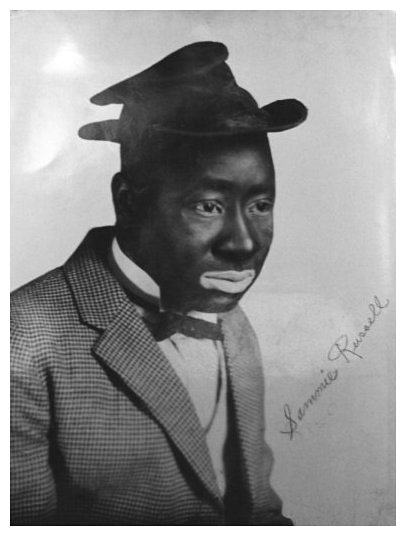
I didn’t name the “Jelly Roll Blues” the “Jelly Roll Blues.” It was named by the people of the city of Chicago. How I happened to get the name myself thrown on me as an alias was due to the fact, in the show business, with one of my old partners, a black-face comedian and the first eccentric dancer in the United States — Sammie Russell, who was later known as Barlow, the teammate of Sandy Burns. One night, while working ad lib on the stage doing comedy, Sam said to me, “You don’t know who you’re talking to.” I told him I didn’t care, and we had a little argument. I finally asked him who was he. And he stated to me, he was Sweet Papa Cream Puff, right out of the bakery shop. That seemed to produce a great big laugh.
While I was standing there mugging, as you call it, the thought came to me that I’d better say something about the bakery shop. I said to him, he didn’t know who he was talking to. He finally wanted to get acquainted, so he asked me who was I. And I stated to him, I was Sweet Papa Jelly Roll with stovepipes in my hips, and all the women in town was dyin’ to turn my damper down.
What you mean by saying you had stovepipes in your hips? Well, stovepipes — I don’t know — it was one of these kind of a things, you know, very warm — hot hips. So the people automatically named it. But my original title for this tune was the “Chicago Blues.” I’ll now try to see if we can’t do a little bit of it.
Original Jelly Roll Blues [begun]
I remember how the folks used to say when I used to play, to get around to chitlin suppers after work hours and play these things — why, they said, “Boy, bring me some more o’ those chitlins,” see? [laughs]
Note: Jelly Roll incorrectly recalls Sammie Russell’s stage name as Barlow.
Note: Jazz historian Paige van Vorst provides a rare signed photograph of the vaudeville artist Sammie Russell mentioned by Jelly Roll above. Sammie Russell was also known as Bilo. [PVV 1]
1660 A
|
a
|
1660 A
|
b
|
Jelly Roll Blues — v/sp/p
|
c
|
Jelly Roll (20)
Jelly Roll Blues (completed)
The ending you have on all the pieces now is the ending of the Jelly Roll Blues
|
d
|
ORIGINAL JELLY ROLL BLUES
|
e
|
Circle jm-74 (excerpt)
|
f
|
Rounder CD 1092 as: ORIGINAL JELLY ROLL BLUES, concluded
|
g
|
Rounder CD 1888 as: Original Jelly Roll Blues
|
|
Original Jelly Roll Blues [concluded]
This is the way I used to sing in the Elite.
In New Orleans, in New Orleans, Louisiana town,
There’s the finest boy for many miles around,
Lord, Mister Jelly Roll, affection he has stole.
What? No. I sure must say, babe,
Certainly can’t abuse, just can’t confuse.
Isn’t that a shame?
Don’t you know the strain?
That’s those Jelly Roll Blues.
He’s so tall, so chancy,
He’s the ladies’ fancy.
Everybody knows him,
Certainly do adore him.
When you see him strolling,
Everybody opens up,
He’s red hot stuff.
Friends, you can’t get enough,
Play it soft, don’t abuse,
Play some Jelly Roll Blues.
[clears throat]
See, that’s my foot there you hear, here. Every, everybody in the world who’s ever heard me remembers the foot, see? That’s how I started gettin’ the four beats to ‘em.
[inaudible comments] Huh?
[inaudible comments] . . . “Jelly Roll Blues,” the song . . .
Where’d you start getting the four beats? Er, right from the foot — the way I used to tap my foot, you know. That’s how it started. Of course, “The Pearls” brought it out in later years. Yes, nobody did that for years but me. That’s how the four beats came. They used to beat what you call two beats to the measure.
He’s tall and chancy,
He’s the ladies’ fancy,
Everybody knows him,
Certainly do adore him.
When they see him strolling,
Everybody opens up,
He’s red hot stuff,
Friends, you can’t get enough,
Play it soft, don’t abuse,
Play those Jelly Roll Blues.
That’s a . . .
Note: The Elite #2 Café was located at 3445 South State Street, Chicago, Illinois.
1660 B
|
a
|
1660 B
|
b
|
Monologue on New Orleans honky-tonks — sp
|
c
|
Blues, honky-tonk
|
d
|
HONKY TONK BLUES II
|
e
|
Circle jm-88
|
f
|
Rounder CD 1092 as: HONKY-TONK BLUES (excerpt)
|
g
|
Rounder CD 1888 as: Honky Tonk Blues
|
|
Honky Tonk Blues
I could sit right here and think a thousand miles away,
I could sit right here and think a thousand miles away,
Since I had the blues this bad, I cannot remember the day.
I wish that I had never was born,
I wish the day that I never was born,
To see that man kill my baby and he’s gone.
I’ll never get a sweet man like that anymore,
I’ll never get a sweet man like that anymore,
He had that thing, all the women was callin’ for.
Plays chords softly as he speaks
I’d like to explain you somethin’ about the old-time honky tonks. When anyone said honky tonks in the city of New Orleans — of course, they’d spread it out in different places. For an instance, they spread it out maybe in Memphis, like Jim Kinnane’s and that bunch. A honky tonk — for an instance we’ll say Kaiser’s, one of the biggest honky tonks in New Orleans, and Spano’s. They were terrible honky tonks, where occasionally it would be nothin’ for a man to be drug out there dead. The place’d be wide open just the same, no trouble happening. They ran twenty-four hours a day. Mostly at night was when the attendants was there.
The attendants was such as some of the lowest calibre women in the world. Some of them maybe didn’t bathe in six months, and maybe they wouldn’t bathe then, but only in a tin tub. And the men — I have personally seen some of ‘em that was actually lousy. They would reach up, maybe in their collar — if they seen a decent person come in and formed a dislike for ‘em — and get one of those educated louses, I guess, and positively throw onto the person when his back was turned. There were so many that became lousy and didn’t know how they got to be lousy.
The main intake for these honky tonks was the revenue that would come from the little pitiful gambling games, a lotta times waiting for a sucker to come in. But if one came in — don’t worry, he would be really taken — they never had a chance to win. And the odds was so much against any stranger because of the tough calibre that hung there.
And, of course, there would be a few drinks bought and so forth and on . . .
1661 A
|
a
|
1661 A
|
b
|
Monologue on New Orleans tough characters — sp
|
c
|
Jelly Roll (21)
The Honky Tonk
|
d
|
“They were tough babies”
|
e
|
Circle jm-88 (excerpt)
Circle jm-37 (excerpt)
|
f
|
—
|
g
|
Rounder CD 1888 as: Real Tough Boys
|
|
Plays chords softly as he speaks
As I before said, that they always had some kind of a gambling game going. And if you ever decided to try to play cotch, which is strictly a New Orleans game — the three-card Spanish poker. You deal from the bottom of the deck. The way those guys could shove those cards at the bottom of the deck and pull ‘em — of course, you pulled your cards from the bottom of the deck to deal. Boy, they’d have a legay in no time.
Of course, among some of those really tough boys, there were men like Chicken Dick. Chicken Dick was a real tough guy, a wolf. Oh, he was a tough guy, real tough. Had, he had shoulders on him and arms, well, much more stronger looking than Joe Louis.
Aaron Harris, no doubt, was the toughest of ‘em all. He was a known killer. A very dangerous character that had very little to say. I know many instances where the policemens wanted Aaron, but they couldn’t afford to say very much to Aaron unless they intended to kill him. And they was afraid that if they tried, that their life would be in danger. It seemed like he never missed. Any time he got ready to kill — anyone, man or woman, made no difference, because he killed his sister — he’d never miss. He’d kill you when he wanted to.
Toodloo Parker was also a very tough guy. He was a man that you couldn’t bother with, but they all respected Aaron Harris. Sheep Bite was the toughest guy you ever seen in the world until Aaron Harris walked up. When Aaron Har . . . Harris walked up why, he was just the same as a lamb.
I knew Sheep Bite very well. I was raised with up him. In fact I know all of these boys very well. Of course, he was a real big-mouth tough guy. And if he could bluff you, then he would murder you, if it was necessary.
What would he say? Oh, I couldn’t afford to say the words that he would say.
Go ahead and say it. Oh, there’s a lady in the house and I couldn’t afford to say . . .
Say it in front of me. Er, must I say the word like that in front of the lady? Well, I tell you, his chief words . . . When he’d walk into a gambling house everybody would start quittin’ — he’d say, “Cash in my checks there, I gotta go.” He’d say, “You motherfucker, you gonna play. Sheep Bite’s here and I’m the baddest son-of-a-bitch that ever moved. And set down there and play, and, if you don’t, I’m taking this money.” Of course it made no difference whether he lost or won. He took the money, unless Aaron was there. Then when Aaron was there he was very polite.
Well, er, Toodlum was a very tough guy too. And, er, he was a very dangerous man to fool with. But he respected Aaron Harris too. They all respected Aaron.
Ernest Mayfield was a kid that claimed that he’s, er, he was here even before the Mayflower sailed that is . . . I mean his, his, er, parents. He looked very much like an Indian and claimed that all his relations were Indians. He was a dangerous man with a gun. He would shoot you in two minutes. Never fought anybody with his fists. And never . . . nobody cared to bother with him. Even Aaron Harris figured that he was kinda treacherous, and he may get you with your back turned, because he was known to get you any time you did anything to him at all.
They had a very tough bunch . . . of boys. No doubt, there’s some of them still livin’ that frequented one of the corners where I used to sing in the quartets, at Jackson and South Robertson — they called it Jackson and Locust, those days. A very tough gang hung out there — the Pickett Boys. There was Buss, there was Nert, there was Nonny, there was Bob. And they had another one. I don’t remember his name. Well, they lived way back of town, as they called it in New Orleans, out Jackson Street.
Were these guys thieves as well as, er, tough guys? I, I really don’t know how they made their livin’, but I didn’t . . .
Were they sweetback men? I really think that they really was sweetback men. They always had a lot of women running after ‘em. Anyway, they were very tough. The policemen was known to never cross Claiborne Avenue. And they lived five blocks beyond Claiborne, at Galvez. They were tough babies.
Note: Circle jm-37 does not contain the underlined profanity.
Note: Jelly Roll described Ernest Mayfield as an American Indian, or at least part American Indian. The 1910 U.S. Census, however, recorded his race as mulatto, but it is probable that the assessment of Jelly Roll, a keen observer of people, was substantially correct. He was born in Bay St. Louis, Mississippi, (about 50 miles from New Orleans) in March 1890, and was brought up by his grandfather, Edward Moore. He later moved to New Orleans and was employed as a wagon driver. In 1910, he was living with his aunt, Sallie Epps, at 1420 St. Thomas Street in the 11th Ward of New Orleans. He may have been treacherous and a person to treat with great caution, but he did not live long to experience much of life. Ernest Mayfield died in New Orleans on 29th May 1910, only a few months after he turned 20 year of age. [PH 5]
1661 B
|
a
|
1661 B
|
b
|
Monologue on New Orleans tough characters — sp
|
c
|
same. cont’d
|
d
|
‘SHOOTING THE AGATE’
|
e
|
Circle jm-11
|
f
|
—
|
g
|
Rounder CD 1888 as: Sporting Attire and Shooting the Agate
|
|
Plays chords softly as he speaks
Nert had a burned hand, and he used to wear a kind of stocking over it. He was seemingly simple, to me. I think he was a half-wit. In fact I’m sure that he was.
[both laugh]
He would laugh and go on and he wanted to have a some kind of a important — and he wanted to be known as such.
All those boys in New Orleans dressed very well. But they all had the real tight trousers, those days. When they’d get into their trousers, why, they’d fit ‘em like a sausage.
[laughs] Of course, Bertenards and Wagners were the tailors, and they know’d just how they wanted those clothes and they would fit ‘em that way.
I’m telling you, it was very, very seldom that you really could button the top button of a person’s trousers. They had to leave the, had to leave the trousers’ top buttons open. And they had the suspenders and — of course, they didn’t really need any suspenders because they was so tight fitting. And it was one of the fads that they would take one suspender down, as they would walk along, oh, er, with a walk that they had adopted from the river, which they call shooting the agate.
[both laugh]
Well, Nert would come along shooting the agate, and leave his shirt open in the summertime, so you could, er, discern his red flannel undershirt. That was considered a big thing with some of the real illiterate women. If you could shoot a good agate, and had a nice high-class undershirt with a flannel shirt with the, the collar turned up, boy, I’m telling you, you liable to be able to get next to that broad. She’d like that very much.
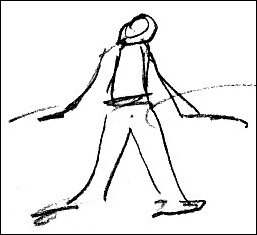
What . . . How did they walk when they shot the agate? Well, of course, er, by not being able to walk, I can’t explain it to you. But I tell you, it was a kind of a very mosey walk, with the holding two fingers down of one finger on each hand, the, the front finger next to, er . . . in other words, the index finger. Yeah, like that, you know, and with their arms stiffed out, you know, especially when they would be standing. And if . . . of course, if they was dressed up and you tried to talk to ‘em, they would find the, the nearest post — when, they have a lot of creases in their clothes, or get to a house — and they’d stiffen their arm out and hold theirself so far away, as just as far as their arm would let ‘em, so they wouldn’t get any, er, their clothes soiled. They was very particular about that. Especially . . . Yeah . . .
[both laugh]
Especially some of ‘em, er, they wore . . . That’s right, you’ve got the right idea — with that kind of a broken up, er, stand. Especially some of them would wear overalls — er, overall jumpers, with a high-class, er, pair of trousers maybe costin’ fifteen, or eighteen, or twenty dollars during those days. And of course they wore the best of shoes. And not only shoes. They, they would never . . . nobody would wear a Stetson hat. In those days, myself, I thought I would die unless I had a hat with the emblem of a . . . in it named Stetson. And I wou . . . didn’t rest until I got myself a Stetson hat and a pair Edwin Clapp shoes.
Of course, there was many of ‘em that didn’t wear ready-made shoe . . . shoes at all, during those times. Er, they wore a lot of shoes, er, what they call the St. Louis Flats and the Chicago Flats. These shoes [clears throat] were made, er, with the cork soles on ‘em and no heels and would turn up in the front. A lot of times they would have different designs in the toes of the shoes, er, such as gamblers’ designs, er, such as, er, maybe a club, or a diamond, a heart, or a spade. I have, er, heard later on, that even some of ‘em had made arrangements to have some kind of a electric lightbulbs in their shoes with a battery in their pocket, [laughs] and when they would get around some jane or something that was kind of simple, and thought they could make her — as they call makin ‘em — why, they’d, er, they’d press a button in their pock . . . in their . . . their pocket and light up the . . . the little bitty bulb in the toe of the shoes.
[inaudible comments] Oh, it is really the fact. And I’ve known it to be fact because it has come . . . that part has come from authentic source. But the others, I have really seen myself to know it’s really original stuff.
Er, these boys were tremendous, and they were great sports. It was nothin’ like spending money that even worried their mind. If they didn’t have it, somebody else had it and would spend it for ‘em.
Note: On the dust jacket, Alan Lomax has sketched a caricature of a man Shootin’ the Agate along with the following text: Truckin’ originated from Shootin’ the Agate.
Note: Jelly Roll mispronounces the name Bertonneau as Bert-en-ards. The firm traded as Bertonneau Bros. and was founded by Arnold Bertonneau (1834-1912) and his brother Louis. Their shop was located at 392 Dryades Street, New Orleans. It is probable that Jelly Roll’s grandfather, Julien Monette, who was a tailor by occupation, worked for the Bertonneaus. It is certain they knew each other, for they both held the rank of captain in the 6th Louisiana Infantry in the Civil War, and both were members of the Louisiana Constitutional Convention of 1868. Julien Monette named one of his sons Arnold Pierre. The Bertonneaus were light skinned Creoles who were passing for white by 1900. Arnold and Louis and some other family members left New Orleans in 1901 for Los Angeles, California. In 1910 Bertonneau Bros. was run by Albert and Gaston Bertonneau, the sons of Arnold. Wagners was operated by John H. Wagner, from a shop at 174 South Rampart Street, New Orleans. [PH 3]
1662 A
|
a
|
1662 A
|
b
|
C. C. Rider — v/sp/p
|
c
|
Jelly Roll (22)
The Sweet Back Men
Lindy - one of their songs.
C. C. Rider
He says that is a late song song first popularized by Victoria Spivey in 1927 (?)
|
d
|
I. ‘NO DOUBT THE FINEST FOOD’
II. SEE SEE RIDER (beg.)
|
e
|
Circle jm-12 (excerpt)
|
f
|
Rounder CD 1092 as: C.C. RIDER, begun (excerpt)
|
g
|
Rounder CD 1888 as: Sweet Mamas and Sweet Papas
|
|
Plays chords softly as he speaks
It really was a miracle . . .
[coughs and clears throat]
That whisky was certainly was wonderful. That’s how some of the boys used to say, you know, when they’d get drunk. Yes, indeed.
It was a miracle to see how some of the boys lived. Today, why, they wouldn’t even think of that particular type of living. But they didn’t care. The fact they was all neat, and they all strived to at least to have a Sunday suit. And without a Sunday suit, why, you didn’t have anything. But not the kind of suits that you wear today. The boys wouldn’t wear anything but a blue coat and some kind of a stripes. That was considered a suit. And if you really came up with all the goods, as they wore in a suit, why, you was considered outta line.
There’s a many time they would kid me and tell me, “Boy, you come from the country. Here you got trousers on the same as your coat. You’re way out of line. There’s no question about it.”
Now these, er, these boys used to all have a sweet mama. Well, er, of course in that class there they was what you’d call, er . . . I guess I’ll have to tell it as, as it is. They wasn’t much of, er, what . . . I’d call ‘em maybe a, a fifth-class whore. They got somethin’ when they could, and when they couldn’t, why, they would, er, work out in the, in the yards. A lot of ‘em worked out to . . . the coloured girls worked out in white people’s yards. Of course, it applied just the same as, er, with the col . . . er, poorer class white people, the same way. They all practically lived out in the same section together. There was no such a thing as a segregation at all, in that section. In fact, nowhere in New Orleans, at that time.
Well, every night the boys would hang around. Some of them would even go so far to meet their sweet mamas. St. Charles Street was quite along ways off. But sometimes they would brave it and walk to where their sweet mamas were working.
And of course, sometimes, it was okay for them to go into the house. And they would, er, keep ‘em out in what they call the servants’ room. And, if they was hungry, well of course they’d feed ‘em there. And, if they wasn’t hungry, why, they’d bring a pan out. I’ll tell you, sometimes in fact I’ve tried those pans myself. Some of those pans were marvellous, I’m telling you.
See, the girls, the way they would do — whoever they would be working for — for instant, they would be working for maybe the Godchauxs or Solaris, or whoever they would be working. I know these names, because I’ve been in some of the homes, myself, seeking after a pan. Er, for instant, they would cook turkey. And it would be up to them maybe to carve the turkey. Well, for their sweet papas, why, they’d keep the best part of the turkey. There’s no argument to that. They’d have better than any of ‘em would have. There’s no question about it — cranberry sauce and every other thing. It wouldn’t have to be Christmas for this, because New Orleans is a place where, no doubt the finest food in the world prevails.
They would have gumbos, especially, and oysters of all kinds — the Bayou-cooked oysters. And you could hear ‘em sometimes after they get home, and would get around. Sometimes they would get around all together — maybe a whole lot of sweet mamas and there’s a lot of sweet papas — and they’d have a little bit o’ ball to their self.
And they would play the blues. Sometimes, Josky Adams . . . I was quite small, but I’d get in on those pans occasionally. Josky was much larger than me and much older. [clears throat]
That whisky is marvel . . . just lovely.
Why, er, I used to go with Josky’s sister. He had a beautiful sister, and I always had it in my mind that I wanted to marry her. I used to come . . . sometimes go over to his house and hear him play the blues and he’d sound like this.
See See Rider [begun]
That would be behind his sister’s and mother’s back.
She said, “See, see, rider, see what you have done,
See, see, rider, see what you have done.”
Note: The French name Godchaux is mispronounced by Jelly Roll as Go-show — where it should be God-show. There were a number of persons with the surname of Godchaux living in St. Charles Avenue and surrounding streets in New Orleans at the beginning of the 20th century. Many of them were first generation New Orleanians, with fathers born in either France or Germany. [PH 4]
1662 B
|
a
|
1662 B
|
b
|
C. C. Rider — v/sp/p
|
c
|
same, cont’d.
|
d
|
SEE SEE RIDER (concl.)
|
e
|
Circle jm-13
Circle jm-75 (excerpt)
|
f
|
Rounder CD 1092 as: C.C. RIDER, concluded (excerpt)
|
g
|
Rounder CD 1888 as: See See Rider
|
|
See See Rider [concluded]
See, see, rider, see what you have done,
See, see, rider, see what you have done,
You made me like you, now your man done come.
I want a mama that’s gonna be good to me,
I want a mama that’s gonna be good to me,
I want a mama, one as sweet as can be.
I want a gal that works in the white folks’ yard,
I want a gal, works in the white folks’ yard,
I want a gal that works in the white folks’ yard.
This is a verse I used to always like, see.
Do you see that little fly crawling up the wall,
Oh, do you see that little fly climbing up the wall?
She’s going up there to get her ashes hauled.
I’ve got a mama, she lives right back of the jail.
My, my.
I got a sweet mama, she lives right back of the jail,
[inaudible comments]
She’s got on a sign on her window, ‘Good pussy for sale.’
I’m tellin’ you, those guys used to do all that stuff, see, er, and while the family’s there, you’d have, have a wonderful time. And, er, I’m tellin’ you, they had a, had a lot of things that really happened around there. I was a kid around then. I always wanted to be hanging out with big men. I guess that’s one reason why they think I’m even older than what I am.
They used to have clubs. They used to have the Broadway Swells and the High Arts and all clubs all over the city. For an instant, they had, er, these clubs. There’s always one would parade at least once a week. Every Sunday there was a parade in New Orleans. They’d have a great big band, and they would have horses, and they would have big streamers and things that cost plenty of money. And, er, one would out, outdo the other, try to outdo the other. They’d get the best bands and . . . but they all had their streamers and their sashes, er, for things like that. Why, they’d have it made at Betat’s. Betat’s was the best there was in the city. Er, these things cost plenty of money
And, of course, they decided once that they wanted to take a kid into the Broadway Swells and have him parade. The men that rode on, on the horsebacks — er, they called, they were called aides. And of course, they give me an invitation, because at that time I was considered the best dresser. Of course, my people always had me wearing diamonds since, I guess, I was just a baby. And I always had some kind of a diamond on, and they would just figured I was a smart kid. I accepted the invitation all right.
Note: Mrs. Achille Betat, (Flags and Regalia) 239 Canal Street, New Orleans. (1877 New Orleans City Directory, Orleans Parish, Louisiana) [MG 2]
1663 A
|
a
|
1663 A
|
b
|
Monologue on New Orleans clubs, parades and fights — v/sp/p
|
c
|
Jelly Roll (23)
The Broadway Swells Club
|
d
|
THE BROADWAY SWELLS Part I
|
e
|
Circle jm-75
|
f
|
—
|
g
|
Rounder CD 1888 as: Parading with the Broadway Swells
|
|
Plays chords softly as he speaks
So they decided, said, “This is, er, the smartest kid around, so, er . . . and, of most of the kids is so poor, he can get anything he wants. Er, in order to beat these other clubs, I think we ought to make this kid a kind of honorary member of the Broadway Swells.” And they spoke to me and asked me, says, “What do you think about it kid?” Said, “Do you, er, think that you could get a horse? A horse’d cost you five dollars for that day. And of course you’d have to have a streamer. And you’d be a honorary member of the Broadway Swells.”
I thought that was a swell idea. And I personally accepted.
Of course these clubs didn’t, er, come, er, come up with such clubs as the Orleans Aides, and the Tramps, and the Bulls and Bears, and so forth and so on.
[clears throat]
These were different clubs, for an instant. And they had some higher-class clubs, er, like the Iroquois and the Allegros. Of course they was . . . these were much finer clubs with the higher-class people and people that could afford much more.
I’ll be honest with you, I have never seen such beautiful clubs as they had in the city of New Orleans. And of course, they all had their cliques, and they had their, their surroundings to be bothered with.
I accepted the idea and er, they wanted to be the first to display a kid as a aide. And I rode about in the second line of the horses, which was very, very far in front. The grand marshal was number one. He rode the horse in the centre, and they would ride two horses — that is side by side — after that. And I rode in the second line.
And of course, my horse wasn’t up to the minute, and the boys just kidded me terribly because my horse was small. I thought I should have a small horse, since I was nothin’ but a kid. And the funny part of it, the horse that I rented — why, they didn’t, er, shear him. And he had long hair on, and everybody’s horse was slick and shiny. And the kids that was around that was jealous of me, was calling my horse a goat, and would take my horse up by the front knees and say, “We can truck this horse on our back.” Say, “You should be riding the horse. Don’t let the horse ride . . . [laughs] Don’t you let . . . you ride on the horse. You ride the horse.”
And, of course, I went along. I got angry two or three times and I nearly beat the horse to death. Because I wanted to show ‘em that I had a good horse and he could run fast. I’m telling you the truth, up until today, that’s one of the things I feel most sorry for — was the way I beat that horse that day to try to make him prove that he was a good horse. Of course, I shouldn’t have had such a ambition to try to prove to the boys what I did.
Well, anyway, we went along, and, er, of course, every member in, in the organization that can afford, they always have, er, at their home — they have maybe a barrel of beer. Never a half a barrel — a real barrel. Of course, not what, I mean, they’d have a barrel of today. They’d have that and plenty sandwiches, and a lot of whisky and gin and so forth.
Well, everybody in the neighbourhood — of whichever these beers would be, or the, we’ll say the, the Grand Salute — why, they would have women on top of women, children and everybody and second lines just followin’ the band and the parade. And of course, if they had ten fights that day, they didn’t have many.
And, er, of course, er, they would, er, start on one side of the street — for an instance, like, er, er, the house that . . . left-hand side. They would parade and go up the right-hand side and go all around to the next block, and then come down the left-hand side to get to the place. And there would be a grand opening right there, and the band would play in front of the place while everybody marched. And the boys would go in and, of course, er, all the organizations would get their food and their drinks first. And they’d drink and have a hell of a time right there, and there might be a big fight before they get out of there, and there’d be more argument. And when they would get through, then the band would drink. They would have enough to drink at that time.
How would they talk in these fights, Jelly? What would they . . . Give us an argument. Oh, they . . . Well if they, if they were, for instance, an argument, well I tell you it’s a tough thing. Er, one guy would say, “Get the hell outta here. Where you get that stuff at? You don’t belong in here.”
Say, “Who said I don’t? Why I live in this neighbourhood.”
Say, “I don’t give a damn if your mammy lives in here. You’re gonna get out of here. If you don’t, you black son-of-a-bitch, I’ll knock your brains out.” And it would start on like that. And pretty soon fists would be flyin’.
1663 B
|
a
|
1663 B
|
b
|
Monologue on New Orleans clubs, parades and fights — v/sp/p
|
c
|
same, cont’d.
|
d
|
THE BROADWAY SWELLS Concluded
|
e
|
Circle jm-76
|
f
|
Rounder CD 1092 as: STARS AND STRIPES FOREVER, incomplete (excerpt)
|
g
|
Rounder CD 1888 as: Fights and Weapons
|
|
Plays chords softly as he speaks
Sometimes it would require maybe a couple of ambulances to come around and, and dig up the people that was maybe cut or shot occasionally. This didn’t happen all the time, but very, very seldom it didn’t happen, see? Er, the fact of it is, there always would be a fight. But there was no parade at no time that you couldn’t find a knot on somebody’s head when somebody had got hit with a stick or something.
They had a tough little guy named Black Benny around there. He was really a tough little egg. He used to hung around the charcoal schooners at the head of the new basin. And anytime Benny was around it was a fight. He would really fight. He’d carry his broomstick, and he’d always wanna be the grand marshal of the second line gang.
[laughs]
And he finally later turned out to be somewhat of a musician — er, Black Benny and Nicodemus also. They was terrible boys to get along with. Of course, sometimes they would get in an argument and there would never be a fight. Er, they would get in an argument like this:
Say, “Listen, don’t cross this line.”
Say, “Why not?”
— “If you cross this line, this’ll be your ass.”
— “Whose ass?”
— “Your ass, that’s whose ass it’ll be.”
Say, “Well, let me tell you somethin’. I don’t give a damn about you and your whole goddamn family.”
Says, “If I hit you, your old double great-grandpa will feel it, see? I’m tellin’ you. So don’t you fool with me.”
And from then on it would go in an argument like that. And sometimes it would never . . . they’d never have a fight. And sometimes they’d wind up being friends.
The second liners — their main instrument was a seven-shooter. They had those little bitty, er, ·22 seven-shooters that shot seven times. I have seen many cases, er, whereby that there’d be an argument and maybe a fellow would be right across the street. I’ve seen one case where a fellow shot seven times and each bullet hit this party and even didn’t go into the skin. They certainly was bad pistols.
[laughs]
[inaudible comments] But if a guy would shoot a pistol — and one of those seven-shooters — nobody would take a chance on him because they’d known of many of ‘em to die from them.
Well, a razors was a very prevalent thing. You could see many razors. Since they didn’t have the razor blades that they have today, like the safety razor — they had the regular old razors. And they would . . . every, every home almost had one of those, because New Orleans was a great place for barbers, and they had many barbers.
Why’d they use a razor in a fight, Jelly? Er, well, they use a . . .
They wouldn’t kill a man, would they? Well, er, they’d do anything as long as they could win. The main object is to win their fight. Whether it was a razor, or whether it was a crowbar or not. It didn’t make any difference.
[laughs]
Why’d they use razors more than knives? Oh, well, a razor had a, er, er, it’s got a sharper edge on it. And of course it can cut you quicker. And, er, and anybody see a razor, they knows it means disaster. So a razor was something that I always moved from if I could see one myself, and I have seen a many of ‘em. In fact, I used to be a barber. I know what a razor is. A razor is a very tough thing. It was one of the first trades I learned, er, being a barber. ‘Course that’s very interesting, too, to talk about my uncle, because he learned me how to be a barber.
Yes, they’d have lots of fights. Well, here’s the way some of the bands would play:
Stars and Stripes Forever
Oh, Buddy Bolden used to blow a mean horn, then.
|